Autonomous regions with their own regime
Each autonomous region has its own tourism law, its own registration number and its own sanction grid. National rules (SES, Modelo 210, LAU) stack on top of — not in place of — the regional ones.

Costa Blanca and the Valencia Region
Decret-ley 9/2024 rewrote the Valencian regime: stays capped at 10 days, room-by-room renting banned, and mandatory community-of-owners certification. The VT licence comes in the format VT-NNNNNN-A (Alicante), V (Valencia) or CS (Castellón).
- Maximum 10 consecutive days per guest (longer → LAU temporada)
- Registration valid for 5 years, renewable with an updated urban-compatibility report
- Regional VT-CV registration; the national NRUA was annulled by the Supreme Court (STS 620/2026)
- Fines up to €600,000 for room-by-room renting or clandestine activity
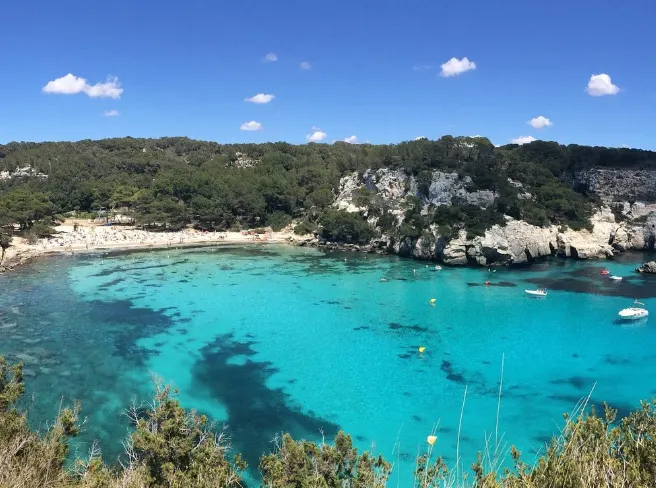
Illes Balears
The Balearic tourist tax (IEET) is collected from the guest and remitted to the ATIB. For typical vacation rentals, settlement is annual via Modelo 017 — not quarterly — with payment between 1 May and 30 June of the following year.
- €2.00 per person per night in high season, €0.50 in low season
- 50 % discount from the ninth consecutive night onwards
- Modelo 017 census filing once on registration — ATIB issues an annual assessment
- Cross-checked against SES.Hospedajes and the Balearic tourism register (ETV)

Catalonia
Catalonia operates a double guest-registry obligation: the national SES AND the Mossos d'Esquadra system (Ordre IRP/418/2010). Skipping one does not exempt you from the other. The HUT regime (Decret 75/2020) defines the Catalan tourist licence.
- Double submission mandatory: national SES + Mossos within 24 hours of check-in
- HUT licence required; without an active HUT number you cannot operate
- City of Barcelona: HUT moratorium since 2018 — no new licences
- Sanctions for operating without HUT: up to €600,000 (Llei 13/2002 art. 92)

Andalusia
The Andalusian regime pivoted in 2024-2025: Decreto 31/2024 renamed VFT to VUT and set capacity ceilings (15 occupants for a whole-home let); Decreto-ley 1/2025 raised fines to €150,000 and now requires a 3/5 community-of-owners vote.
- VUT regime — Decreto 28/2016 as amended by Decreto 31/2024
- Registration with the Registro de Turismo de Andalucía (RTA), code VUT/<province>/<number>
- 3/5 community-of-owners consent required (Decreto-ley 1/2025)
- Fines up to €150,000 (art. 78 Ley 13/2011) — more than 13,000 cancelled registrations in 2025-2026

Seville (city)
A municipal layer on top of the Andalusian regime: the city council's 17 October 2024 ruling sets a 10 % VUT cap per neighbourhood — Casco Antiguo and Triana-Casco are de facto closed to new VUT, and since 2022 the PGOU reclassifies VUT as terciario hospedaje (no longer a residential use).
- 10 % VUT cap per barrio — 11 saturated neighbourhoods already closed
- Declaración Responsable for change of use at Gerencia de Urbanismo
- No tourist tax: the Junta blocks the framework Mayor Sanz is requesting
- LISTA sanctions + €150,000 autonomous fines + cease-of-activity orders

Comunidad de Madrid
Decreto 27/2026 tightened the autonomous regime as of 26 April 2026 (minimum 25 m², enhanced fittings, CIVUT certificate); the city's Plan RESIDE simultaneously blocks most new VUT in the central ring of Madrid.
- Decreto 27/2026 — minimum 25 m² + three-year transition
- CIVUT certificate required (Decreto 29/2019), issued by chartered technician
- Plan RESIDE Ayuntamiento: whole-building 15-year rule + 60 % community veto
- Sanctions Ley 1/1999 up to €300,000 + €30,000-190,000 municipal

Canary Islands
Ley 6/2025 of 10 December reshaped the regime: VV can no longer be declared freely; it requires prior municipal urban habilitation, with a 10 % cap on the tourist islands (90 % residential floor) and 20 % on the green islands.
- Ley 6/2025 — prior municipal urban habilitation now required
- 5-year transition + declaration of consolidated tourist use
- IGIC 7 % (not IVA) — ZEC not applicable to VV, no autonomous ecotax
- Major sanctions €15,000-150,000 + cease-of-activity
National rules that always apply
Wherever the property sits, three national rules always apply: SES.Hospedajes (guest register), Modelo 210 (IRNR for non-residents) and the LAU (the line between tourist use and seasonal rental). Read them as the mandatory layer on top of the regional pillar.
SES.Hospedajes
Reporting guest data to the Ministry of the Interior within 24 hours (RD 933/2021). Applies with or without a tourist licence.
Modelo 210 (IRNR)
If you are not a Spanish tax resident, you declare rental income at 19 % (EU) or 24 % (non-EU) — annual aggregation since 2024.
LAU art. 2 / 3 / 5
The legal boundary between primary residence, seasonal rental and tourist use. Determines which regional regime applies to you.
Lost in the acronyms?
VT, HUT, ETV, NIE, IBI, IEET, RD 933, Cl@ve PIN... each one has its own dedicated micro-page.